


Saving the Heart Without Harming the Kidneys: A Game-Changing Cardiac Procedure
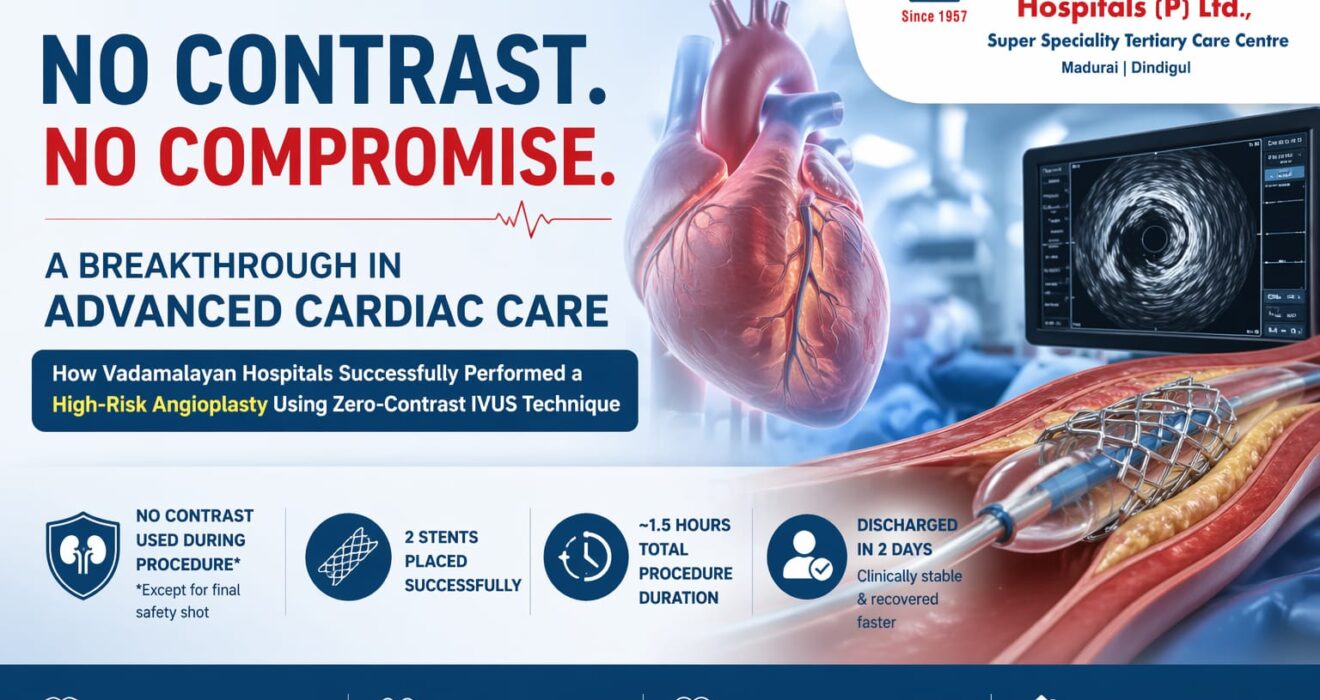
How Vadamalayan Hospitals, Dindigul Successfully Performed a High-Risk Angioplasty Using Zero-Contrast IVUS Technique
Advanced Technology. Safer Outcomes. Faster Recovery.
Zero-Contrast PCI with IVUS Guidance — A Landmark
Procedure for a High-Risk Patient
Dr. Vignesh Kumar M
MBBS · MD (Internal Medicine) · DM (Cardiology)
In modern interventional cardiology, every decision is a careful balance between benefit and risk. For a patient whose heart and kidneys are both under siege, this balance becomes extraordinarily delicate. On April 14, 2026, our cardiac catheterisation laboratory at Vadamalayan Hospitals, Dindigul, performed a procedure that exemplifies how innovation and precision can together rewrite the odds — a successful Zero-Contrast PCI in a critically complex patient.
The Patient and His Predicament
Our patient — a 62-year-old gentleman — arrived with a formidable constellation of medical challenges. He was a known case of Type 2 Diabetes Mellitus and had been living with chronic kidney disease (CKD) at its most advanced stage — End-Stage Renal Disease (ESRD) on MHD, indicating severely compromised kidney function that leaves little physiological reserve for any additional insult.
Compounding this, he had recently suffered an Acute Coronary Syndrome — specifically a Non-ST Elevation Myocardial Infarction (NSTEMI), commonly known as a heart attack. A coronary angiogram performed to evaluate the extent of damage revealed blockages in two of his coronary arteries and significant blockages in One of them — the crucial blood vessels that supply blood and oxygen to the heart muscle. He needed coronary angioplasty for that significantly blocked artery.
The Clinical Dilemma
Standard coronary angioplasty requires iodinated contrast agents — typically 80 to 100 ml or more for a complex, multi-vessel case. In patients with normal kidneys, this is well-tolerated. In a patient with ESRD, however, the same contrast can precipitate sudden worsening of renal function (Superadded contrast induced nephropathy) and trigger acute pulmonary oedema (severe breathing difficulty) that may necessitate emergency ventilatory support.
Understanding Zero-Contrast PCI
Traditionally, contrast agents are indispensable during angioplasty — they render blood vessels visible under X-ray fluoroscopy, guiding the cardiologist’s every move. Without contrast, the interior of a coronary artery is effectively invisible on conventional imaging.
What is Zero-Contrast PCI?
Zero-Contrast PCI (Percutaneous Coronary Intervention) is an advanced technique where the entire angioplasty procedure — including wire navigation, balloon dilatation, and stent deployment — is performed without using any iodinated contrast agent, relying instead on intravascular imaging and meticulous technique. A single, minimal “safety shot” of contrast at the very end is permitted to confirm the final result.
The key enabler of this approach is Intravascular Ultrasound (IVUS) — a miniaturised ultrasound probe mounted on a catheter, inserted into the coronary artery itself.
The Procedure: Precision Under Pressure
The procedure was planned meticulously. Given the severity of the patient’s renal impairment and the anatomical complexity of his coronary disease — two significant blockages in one coronary artery requiring dual stenting — this was far from a straightforward case.
With IVUS as the primary navigational tool, our team performed a complex, two-stent angioplasty in a single coronary artery, deploying both stents with precision guided entirely by intravascular ultrasound imaging. The procedure demanded sustained concentration, technical dexterity, and confident decision-making at every step.
0 ml
CONTRAST USED DURING PROCEDURE
(EXCEPT FOR FINAL SAFETY SHOT)
2
STENTS PLACED SUCCESSFULLY
~1.5 Hours
TOTAL PROCEDURE DURATION
The Outcome: What Zero Contrast Made Possible
No Respiratory Compromise
No acute pulmonary oedema or breathing difficulty developed — a complication that often
requires emergency intubation and ventilation in similar patients.
Kidneys Not Hit Further
There was no contrast-induced worsening of his already precarious renal function —
a critical outcome for a patient with end-stage renal disease.
Coronary Blockages Opened
Both significant blockages were successfully treated with stents, restoring normal blood flow
to the jeopardised heart muscle.
Discharged in 2 Days
The patient was discharged home just two days after the procedure in a clinically stable
condition — a remarkably swift recovery for a case of this complexity.
Why This Matters — The Bigger Picture
The intersection of coronary artery disease and chronic kidney disease is increasingly common in clinical practice. Yet this very combination has historically represented one of the most challenging scenarios in interventional cardiology. Zero-Contrast PCI, supported by IVUS guidance, represents a paradigm shift in how we approach this patient population.
A Note from Dr. Vignesh Kumar M
“Every patient who walks into our catheterisation laboratory deserves the most advanced, safest care available — regardless of the complexity of their condition. Zero-contrast PCI with IVUS guidance is not simply a technical feat; it is a commitment to protecting our most vulnerable patients. We are proud to offer this capability at Vadamalayan Hospitals, Dindigul, and remain dedicated to pushing the boundaries of what is possible in interventional cardiology.”
Dr. Vignesh Kumar M
MBBS · MD, Internal Medicine (Madras Medical College) DM, Cardiology (SJIC&R)
Consultant Interventional Cardiologist, Vadamalayan Hospitals, Dindigul
